I haven't picked a product yet.
Learn how to find ideas, research the buyer, and decide whether the product deserves a paid test.
BEFORE YOU SPEND YOUR FIRST — OR NEXT — $100 ON ADS
Operators Library gives serious beginners and early ecommerce operators one clear system for finding a product, checking the economics, building the offer, creating the ads, launching on Meta, reading the numbers, and deciding what to fix next.
So you can stop piecing the business together from 100 videos, 50 open tabs, random Discord opinions, and tools you are not sure you need.
Starting from zero? Start at the beginning. Already testing? Jump straight to the problem in front of you.
Next: confirm the exact supplier, shipping time, and landed cost, then decide whether the product is ready for paid traffic.
The question is not “what is ecommerce?”
“I found a product. Is it actually worth testing?”
“My CTR and CPC look fine. Why am I getting no sales?”
“How much should I spend before I have enough data?”
“Is the problem my ad, offer, page, checkout, tracking, or product?”
“Should I kill this, keep testing, or scale it?”
If one of those questions has you opening another ten tabs, Operators Library was built for that moment.
Start where you are
Learn how to find ideas, research the buyer, and decide whether the product deserves a paid test.
Check the supplier, margin, price, offer, store, creatives, tracking, and testing budget before Meta starts charging you.
Trace the funnel, compare the result with your economics, and work out whether to fix, keep testing, or stop.
Work through cash flow, AOV, retention, operations, and budget increases without treating more spend as the answer to every problem.
The operating order
You don't need to learn ecommerce all at once. You need to know what job comes next. Start with the product. Get the supplier and economics sorted. Build the offer and store. Make the ads. Launch. Read the result. Then improve the part that deserves attention.
Find
Work through the niche, buyer, demand, competition, problem, and creative potential. The goal is a shortlist you can defend, not a product that merely looks interesting on TikTok.
Then use the Product Test Scorecard to check the demand, buyer, competition, economics, supplier, and creative evidence before you pay Meta to test the assumptions.
Next: confirm the exact supplier, shipping time, and landed cost, then decide whether the product is ready for paid traffic.
Source
Work through supplier choices, sourcing options, shipping, samples where they make sense, and when to move beyond basic sourcing. A product is not ready for a paid test until you know what it actually costs to get it to the customer.
Build
Your selling price, product and shipping cost, fees, offer, product page, and checkout all shape what the first order can support. Operators Library shows you how to check the economics before launch instead of discovering after the campaign that every sale loses money.
Know how much you can afford to spend to get one customer. That is your break-even CPA. Try the calculator with your own numbers.
Before ad spend, this example has $31.53 left per order after product, shipping, and payment fees. Refunds, taxes, and other costs can lower that amount.
Create
Start with the words buyers use, the outcome they want, and the objections that slow them down. Then turn that research into copy, image ads, video ads, and AI workflows instead of asking AI to invent a customer from nothing.
The AI Ad Creative Lab gives you 42 copyable production prompts when it is time to make the assets.
Create an original video ad concept for the fictional Wayfarer Leak-Lock Travel Bottle. Task: script and shot list. Buyer: frequent carry-on traveler. Supported facts: removable silicone gasket, locking collar, three-piece rinse. Use one message, preserve accurate product geometry, and leave safe space for reviewed copy. Do not invent reviews, results, scarcity, credentials, logos, medical claims, or rendered text. Return: concept, composition/shot plan, exact asset list, QA risks, and one single-variable variation.
Launch
Work through Meta setup, tracking, campaign structure, testing budget, what you are testing, and what has to be true before you spend. Change fewer things at once so a weak result does not leave you with five possible explanations.
Read
CTR, CPC, carts, checkouts, purchases, break-even CPA, and funnel leaks point to different problems. Clicks with no carts is not the same diagnosis as four checkouts with no purchase.
This is the difference between tracking numbers and knowing what they mean.
Inspect the final purchase step first. People are making it through the earlier parts of the funnel.
Improve & scale
Work through offer and page improvements, AOV, email, cash flow, retention, operations, and budget increases as the business earns the right to take on the next problem.
More spend is not the answer to every bottleneck. The job is to identify what is holding the business back now, make the change, and see what the next set of numbers says.
Not just another course
Score the product. Work out break-even. Diagnose the campaign. Make the creative. Study the reference. Then open the relevant module when you need the reasoning behind it.
Check demand, buyer, competition, economics, supplier, and creative evidence before you pay Meta to test the assumptions.
Before ad spend, this example has $31.53 left per order after product, shipping, and payment fees. Refunds, taxes, and other costs can lower that amount.
Use your own price, product, shipping, and fee inputs to see how much the first order can afford in acquisition cost.
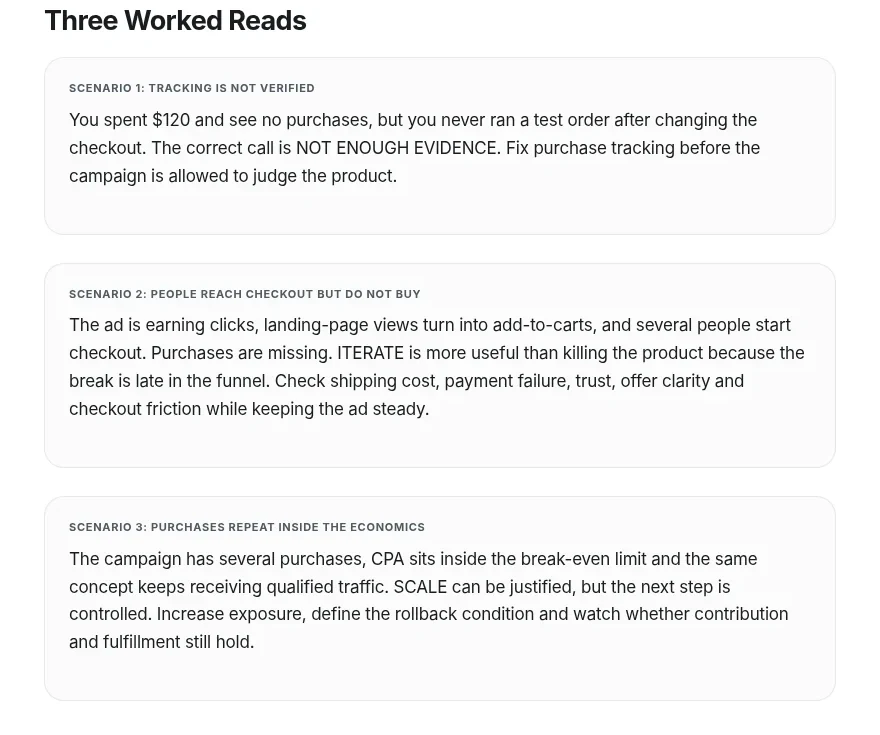
See how campaign context turns into a KILL, HOLD, or SCALE call, with the reason behind it.
Turn a creative brief into a production-ready prompt you can copy and use.
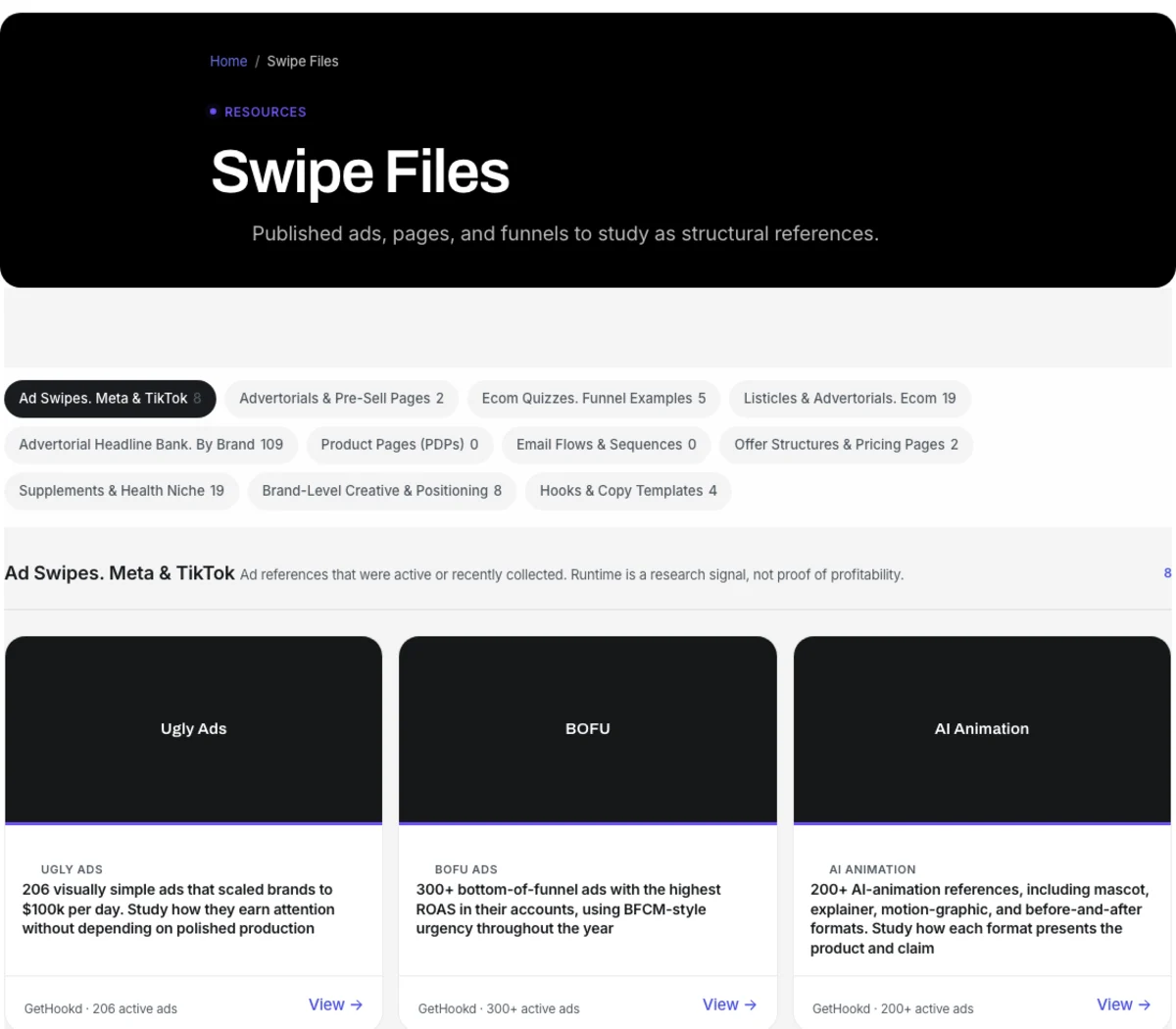
Study published ads, pages, and funnels when you need a reference for structure, hooks, or offers.
The full course stays behind the paywall
Module names and operating order are visible. Paid lesson content stays inside the membership.
Already running ads?
Suppose you spend $118, get 76 clicks, eight add to carts, four checkouts, and zero purchases. That is not the same problem as 76 clicks with zero carts.
The product, ad, page, checkout, tracking, and margin can all produce a weak result. Change three things at once and you may spend again without learning which one mattered.
Read the pattern first. Make one defensible move next.
Follow the sale
The traffic made it through the ad, product page, cart, and into checkout. That makes checkout, payment, shipping surprise, or purchase tracking a better place to investigate before you replace the creative.
Inspect the final purchase step first. People are making it through the earlier parts of the funnel.
Free campaign check
Answer a few quick questions about the test you are running and get a straight verdict with the reason behind it.
Four people reached checkout and nobody purchased. Inspect checkout, shipping, payment, and purchase tracking before you replace the ad.
Use the free check when the numbers are in. Use the full library when you need the economics, product, creative, store, or funnel work behind the decision.
“Can't I learn this free?”
That is not the problem.
You can watch one person explain product research, another explain Meta, read twelve Discord opinions about your metrics, save somebody's spreadsheet, and keep opening new tabs every time a new question appears.
Then your own test comes back and you are still asking: What do I do now?
Operators Library is not selling secret information. It gives the information an order, connects it to your numbers, and puts the tools beside the decisions they help you make.
One place instead of another search
26 modules
Follow the course from Start Here if you are new. If you already have a store, campaign, or scaling problem, jump straight to the module that matches the job in front of you.
Who it's for
Get the order: product → supplier → economics → store → ads → launch.
Check the product, numbers, creative, tracking, and budget before spending.
Diagnose what the numbers mean and what deserves to change next.
Use the scaling, cash-flow, offer, AOV, retention, and operations layers when the next bottleneck appears.
You're looking for someone to hand you a guaranteed winning product, run the store or ads for you, give you private coaching, or promise that your campaigns will be profitable.
Operators Library membership
Get the complete course plus the calculators, scorecards, Campaign Decisions, AI Ad Creative Lab, Swipe Files, Software Toolkit, and member resources.
Choose your billing option on the next page.
Get me accessSame library on either plan. Secure checkout through Whop.Choose your access
Both plans unlock the same 26 modules, decision tools, calculators, AI Ad Creative Lab, Swipe Files, Software Toolkit, and member resources.
Full access. Cancel future renewal from your account and keep access through the period you paid for.
$25/month equivalent. Save $60 versus 12 monthly payments.
Secure checkout through Whop · No free trial · No income, winning-product, or campaign-result guarantee
FAQ
Operators Library
Find the product. Check the numbers. Source it. Build the offer and store. Make the ads. Launch it. Read what happened. Know what deserves attention next.
26 modules · calculators · scorecards · Campaign Decisions · AI Ad Creative Lab · Swipe Files · Software Toolkit