Product Pre-Validation, Run These 6 Checks or Pay for Them Later
Six checkpoints before you spend a dollar. Every operator who skips this module pays thousands of dollars extra testing products that never had a proven market. Products that fail these checks don't fail because of bad luck or bad ads, they fail because the math was broken before the campaign launched. Run every shortlisted product through all six before you build a single page.
Someone finds a product on a spy tool or YouTube video that "looks like a winner." They get excited. They import it to their store in 20 minutes, build a product page, launch their first ad, and spend $250 testing it. Then they discover: Temu has been selling the same product for $4.99 with fast shipping. Or the supplier ships from China with a 22-day delivery window. Or the margin only works at a 6× ROAS, which is nearly impossible for a cold-traffic first test.
This happens constantly. Not to bad operators, to normal ones who were excited and skipped validation. Run it on every shortlisted product, every time, without exception. It's not just $250. Operators waste thousands here, testing products that were never going to work. The $250 you don't waste is the $250 that funds your next test.
This module saves you real money. Run all 6 checkpoints on every product before building anything. Products that fail these checks don't make it in the market.
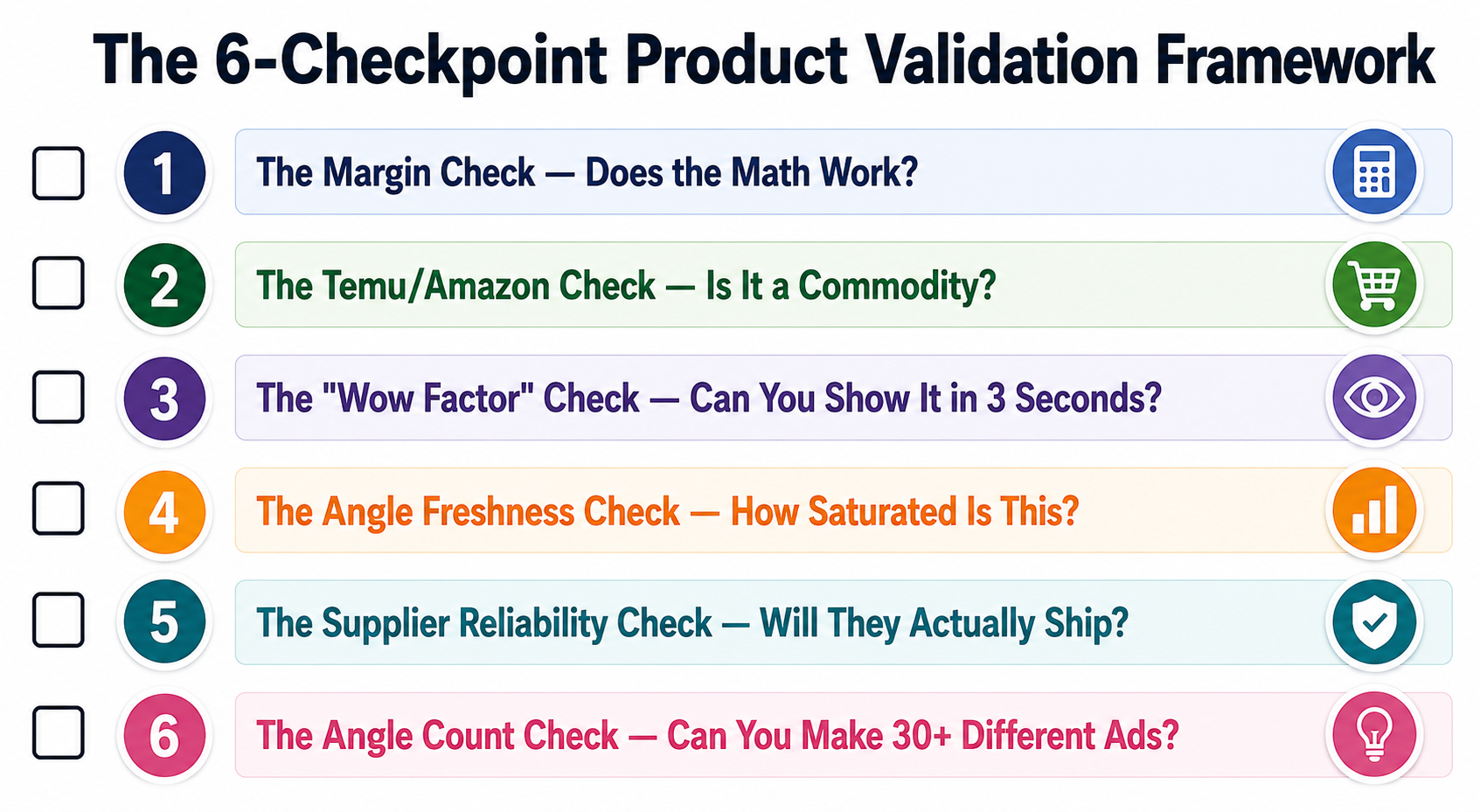
The 6-Checkpoint Product Validation Framework
Your target: sell for 3–4× your landed cost (product + shipping). If you can source for $12 and ship for $4 = $16 landed cost, you need to sell for $48–$64 minimum for viable margins after Meta ad costs. Calculate your break-even ROAS before anything else: Selling Price ÷ Gross Profit = BE ROAS. If BE ROAS requires a 4×+ to break even, the margin is too thin for beginners.
Search the product on Temu and Amazon. If it's available for under $10 with 2-day Prime shipping, you cannot profitably sell it. Your customer will find it for a fraction of your price within seconds. This kills the sale. Products that pass this check are either: (a) not easily findable by generic name, (b) positioned in a way that creates enough brand value to justify a premium, or (c) differentiated by angle.
The best dropshipping products demonstrate their value visually in under 3 seconds. A back stretcher arching someone's spine. A posture corrector showing immediate posture change. A cleaning gadget revealing dramatic before/after results. If you cannot make a compelling hook video by showing the product working, you'll need heavy copy to compensate, and copy converts worse than demonstration for cold audiences.
Open Meta's Ad Library. Search for the product name and category. If you see 50+ ads from multiple advertisers, the product is being tested. If you see one dominant advertiser with 200+ active ads, they've found the winning angle, you'll need a different angle to compete. If you see zero ads, either the product is new (opportunity) or it doesn't work (risk). Find the context.
As a beginner, CJDropshipping is a perfectly decent default. Don't burn hours vetting supplier feedback scores or ratings while you're still testing. CJ's Shopify integration, shipping, and pricing are good enough to validate whether a product sells. The only thing to confirm here: does CJ's price give you a 3–4× markup at your target sell price? If yes, move on. You optimise suppliers later, once the product has proven it's worth optimising for.

Before committing to a product test, brainstorm 6 distinct angles you could run. If you can only think of 2–3 angles, the product has a shallow creative ceiling, you'll exhaust your creative options quickly. Products with multiple clear angles (different avatars, different pain points, different desired outcomes) give you more creative runway and more chances to find a winning message.
The Honest Base Rate
Take your shortlisted 3 products and run each one through all 6 checkpoints. Create a simple spreadsheet: product name across the top, checkpoints down the side. Mark pass/fail. The product with the most passes, and specifically no fails on checkpoints 1 and 2, is your first test. Only one product at a time.
Use this sheet to log your validation results for each shortlisted product, margin check, Temu check, wow factor, saturation, supplier, and angle count. One row per product. Move forward only with the one that passes everything.
Open Tracking Sheet →The honest, community-reported base rate is 5–15 products tested before finding one that's consistently profitable. Not 1. Not 3. Five to fifteen.
This number makes some people quit before they start. It shouldn't, because it changes everything about how you measure progress. If the base rate is 5–15 products, then tests 1, 2, and 3 failing isn't failure, it's par for the course. You're not bad at this. You haven't picked the wrong niche. You haven't made a fatal mistake. You're just on schedule.
The operators who consistently build profitable stores aren't the ones who got lucky on product 2. They're the ones who ran 8 tests with emotional neutrality, treated every failed test as paid data, and kept the process intact until something broke through. The process is the edge. Protect it.

Quick reference — the 5 validation criteria
Run any shortlisted product through these before committing budget.
🧮 Use the Break-Even ROAS Calculator for this step →